


One Clock, Twice the Value
Run Corporate and Sustainability Strategy as One, and Trust Follows.
Business leaders,
Once a year, your organisation runs the single largest act of listening it will undertake. You consult stakeholders, interrogate risk, weigh what matters most to your future, and commit all of it to paper. The exercise is rigorous, expensive, and highly visible. And then, far too often, what it produces gets filed as compliance and never lived as strategy.
The problem is not the report. The problem is when the reporting cycle becomes the main operating rhythm for sustainability strategy itself. A deadline designed to publish can quietly become the deadline to decide.
This results in intelligence arriving through one system while core business decisions are made through another—a pattern researchers call ESG decoupling: the gap between commitment and action. A 2025 review in Corporate Social Responsibility and Environmental Management warns that the rush to meet rigid disclosure deadlines is producing reporting fatigue without meaningful action, with strategy existing only on paper.1 The cause is structural.
A Timeline Problem, Not a Process Problem
Corporate strategy follows the rhythm of board planning, capital allocation, budgets, market expansion, product decisions, M&A, talent and risk appetite.
Sustainability strategy often produces valuable insights into the business. A double materiality assessment may surface real signals on changing customer expectations, human capital and culture issues, regulatory pressure, supply chain exposure, climate risk and emerging growth opportunities.
However, all too often, these two strategic cycles operate on different clocks. By the time the sustainability team is triggered by the next reporting cycle to run materiality and set goals, the corporate budget for the year ahead is already locked in.
This is not a failure of effort. It is a failure of integration. And this is not theoretical. In the past month alone, our teams have heard from multiple clients describing exactly this disconnect between their double materiality assessment, their annual strategic planning and the ability to embed the results into roles and responsibilities. In our experience, this is common rather than exceptional.
Deciding strategy inside the reporting window is writing the script after the film is wrapped.
And the Market Knows
Sophisticated stakeholders can see the difference between a company with an integrated strategy and one with a sustainability strategy sitting beside the business.
Investors and analysts are not simply looking for better claims, they are looking for coherence: whether sustainability is treated as a real business issue linked to governance, capital, risk, long-term value creation and performance.
There is evidence for this. Across more than a thousand studies, NYU Stern’s Center for Sustainable Business and Rockefeller Asset Management found that simply disclosing sustainability information showed little link to financial performance.
And this is not surprising. What counts is real performance: cutting emissions, changing products, managing risk. A positive link to financial results showed up roughly twice as often, 53% of the time against 26%, when a company was measured on what it actually did rather than on what it disclosed.1
Reporting on sustainability barely moves the needle. Acting on sustainability, and proving it, is where value is created.
This is no longer a soft argument about brand or culture. It is a hard one about valuation and the cost of capital. What analysts are really pricing being trust, their conviction that the strategy holds up under scrutiny and that capital is directed where value is genuinely created. Disconnection erodes that trust. Integration earns it.
The strongest examples are companies where sustainability changes the investment logic of the business. Ayala is one. Its listed energy platform ACEN has moved from a largely coal-based portfolio in 2016, when renewables were around 2% of capacity, to 100% renewable generation in 2025. CEO Eric Francia framed it as a “long-term strategy to align ACEN with the future of the energy system, while supporting decarbonization in a commercially disciplined way.”2
The strategy runs across the group, into both products and capital. In June 2026 ACEN’s retail arm and the group’s mobility business, ACMobility, began bundling renewable supply with EV charging for corporate customers, turning sustainability into something the group sells.3 And Ayala Land, now holder of the world’s largest EDGE Zero Carbon-certified office portfolio, raised around a billion US dollars of sustainability-linked financing across 2024 and 2025, with the certification tied directly to those loan terms. Here, sustainability is not adjacent to the value story. It is how the group invests, grows and builds long-term resilience.
Three Movements, in Their Proper Order
The remedy is a rearrangement. Think. Shape. Tell.
Think. Before the Cycle.
Sustainability intelligence should not be governed only by the reporting cycle. It needs to be connected to the corporate strategy cycle. Unfortunately, the former approach still prevails.
A reporting-led assessment asks what is material to disclose. That work remains important. But a ‘strategy-led’ approach asks a different question: how are market, regulatory and social shifts affecting the business model, where are risks and opportunities emerging, and what does this mean for competitive positioning over the next decade?
When framed this way, sustainability becomes business intelligence. It informs capital strategy, planning, product decisions, M&A, talent and brand strategies before the major decisions are made. Stop running two strategies in parallel and start running one.
The same stakeholders and markets that judge your corporate strategy also judge your brand, your employer proposition and your licence to operate. An integrated strategy gives all three a stronger foundation: bolder positioning, stronger talent attraction and a reputation built on evidence rather than assertion, because all three draw on the same foundation.
Shape. During the Season.
Once the thinking is done, the reporting season is transformed. It is no longer the moment you scramble to develop a strategy, but the moment you decide how to communicate it, to everyone, not only to regulators and investors.
This is where storytelling comes into its own, and where the people who design reports do their finest work, they shape how the business is perceived. The task shifts from assembling a compliance document to articulating one integrated strategy across every channel the business uses, of which the report is only one. Financial substance, brand promise and sustainability commitment finally read as one coherent account of the business, because they actually are, and people can see and feel it.
Tell. After the Report, and Everywhere.
A report is not the finish line. It is the starting gun for compelling communication and engagement.
Inside every serious report are stories worth telling, true ones earned through real work, that almost no one will ever read in their original home. The strategy it contains deserves a far wider reach.
Look at the companies that have got this right, such as Ayala mentioned above.Theirabove. Their corporate strategy is their sustainability strategy and, increasingly, their primary revenue engine. Neither tells that story only once a year. Neither needs to.
Across every channel, internal and external, to people, talent, customers, investors and communities. Each needs a different proof point told in a different way. The integrated strategy is the source. The report is one of many channels through which it travels.
This is how a year of serious thinking earns its full return. Not as a document filed and forgotten, but as a story that shapes perception all year, builds reputation, strengthens brand equity, and earns the trust that compounds quietly into enterprise value.
The Ambition Activated Architecture
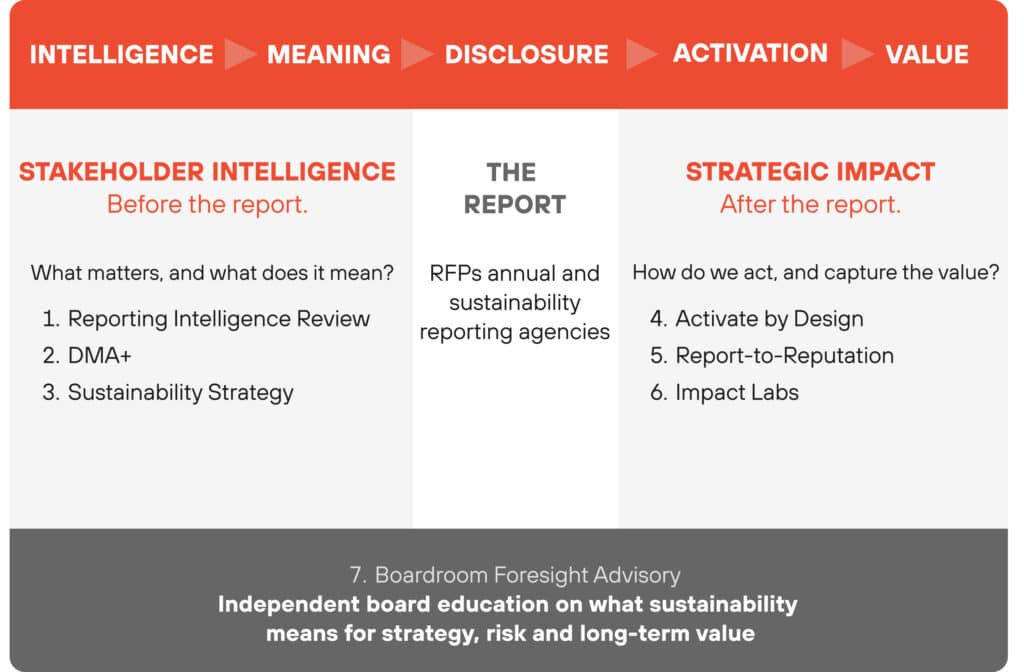
We have built our work around an approach grounded in integrated thinking, which we call Ambition Activated. Three territories of activity, with the report sitting in the middle as one platform among many. Stakeholder Intelligence does the upstream work, before the report, turning data into the intelligence that shapes strategy. Strategic Impact does the downstream work, after it, carrying the strategy into behaviour, reputation and trust, through to the Impact Labs that turn ambition into action. Boardroom Foresight Advisory runs across the full cycle, helping boards understand the implications of sustainability for strategy, risk and long-term value, independently of the executives who brief them.
An integrated report is a publishing choice. An integrated strategy is a leadership choice. We are interested in the second. The report is simply one of the places it shows up.
The Choice in Front of You
Across 40 years of working with businesses in Asia, we have seen stakeholder expectations on sustainability move from disclosure to decision-making. The pressure is no longer only to report progress, but to show how sustainability is shaping strategy, capital, culture and the way the business creates value.
The work that matters is the integrated strategy itself: corporate and sustainability strategies finally running one clock, informing the same capital decisions and articulated through every channel the business uses.
The report is one of those channels: important and worth crafting well. But it is not where the value is made. The value lies in the integrated thinking behind it, and in how that thinking is acted on, evidenced and communicated over time.
Two strategies leak value. One integrated strategy realises it.
And value realised, evidenced and told consistently, year after year, is how a company earns the one asset it cannot manufacture or buy: trust.
If you would like to explore what this could look like for your business, we would be glad to talk.
References
(1) Decoupling in Sustainability Reporting: A Systematic Literature Review (2025), Corporate Social Responsibility and Environmental Management.
(2) The Role of Sustainability Integration into the Corporate Strategy: A Perspective on Analysts’ Perceptions (2024).