




What It Takes to Get PFRS Right
Why the strongest companies will treat PFRS as a capability, not a deadline
For years, sustainability reporting in the Philippines ran on a “comply or explain” approach that gave organisations flexibility in what they disclosed and how rigorously they responded to the requirements. That era is ending with the SEC’s phased rollout of PFRS S1 and S2, mandating IFRS-aligned disclosures for covered companies. Whether you are a Tier 1 company reporting on FY2026, a Tier 2 or 3 company following soon after, or even an entity currently outside the scope of mandatory reporting, the window to prepare is narrowing. Even with the climate-first transition reliefs in place, it is only a matter of time before investors expect more meaningful disclosures that integrate climate and sustainability into risk management and clearly articulate their real effects on financial performance and prospects.
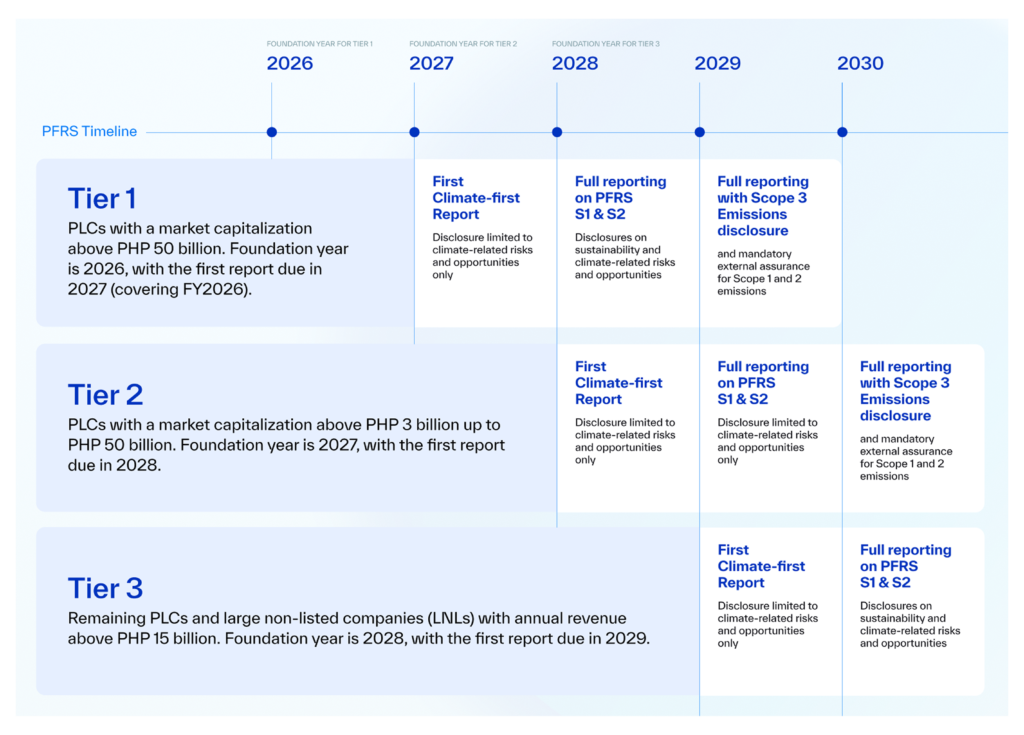
As we advise companies on how best to align with PFRS, it has become clear that whether the standards become a burden or an opportunity depends on the approach they take. Companies that treat PFRS as a deadline will spend the next one to two years scrambling to comply. Those that treat alignment as a capability to be built will emerge with structural advantages over their competitors, underpinned by stronger investor confidence.
The Challenges Are Real, and They Should Not Be Underestimated
PFRS S1 and S2 are designed to reward substance and expose its absence. The standards ask for decision-useful, connected information that goes well beyond the boilerplate language and recycled ESG narratives that may have satisfied the old regime. They also ultimately require full compliance, bringing three challenges to the forefront that many organisations are still working to solve.
The first is silos. Finance, sustainability and operations teams often do not coordinate closely enough, and PFRS makes that gap impossible to hide. The standards require sustainability and climate information to sit alongside financial reporting, with the same rigour and the same reporting timeline. Disconnected teams produce disconnected disclosures, as no single person or team holds clear accountability for addressing newly exposed gaps and coordinating the business response to interconnected issues.
The second is data. Sustainability- and climate-related information is often scattered across departments, held in different formats and based on inconsistent definitions, methodologies and assumptions. Producing the integrated picture PFRS demands is nearly impossible when teams have different concepts of what certain risks and opportunities entail, how they are assessed and how data should fit together. The third is technical and organisational capability. Assessing the financial materiality of sustainability-related risks and opportunities (SRROs) and undertaking climate-related scenario analysis in fulfilment of PFRS S2 are not capabilities that most Philippine teams have yet had reason to build muscle in. These are demanding disciplines that cannot be improvised in the weeks before a filing. More importantly, the governance and cross-functional change management needed to turn technical findings into systemic improvements must be cultivated as soon as possible.
Approached Correctly, PFRS Is a Strategic Opportunity
The organisations that see PFRS only as a new report section will miss what it offers.
Alignment with PFRS is increasingly becoming the price of entry for sustainable financing, ESG-oriented investment and the due diligence processes of multinational partners. Capital and partnerships are moving towards companies that demonstrate their sustainability performance, rather than merely asserting it or gesturing vaguely towards future plans. In this sense, the systems and processes that produce credible disclosures are becoming a commercial asset.
Our approach to scenario analysis brings cross-functional teams together to examine how sustainability- and climate-related risks and opportunities could affect the business across a range of possible futures. This helps pinpoint operational and strategic vulnerabilities that business-as-usual planning may overlook. This is critical in one of the world’s most climate-vulnerable economies, where typhoons cause billions of pesos in damages annually, and climate transition policies are set to redefine how sectors operate in the coming decades. Demonstrating foresight is much more than a reporting nicety; it is essential for building trust with investors in long-term resilience.
Companies that connect sustainability performance to financial outcomes early build a credible story that holds together when investors and regulators start asking harder questions. Serious engagement with PFRS forces strategic clarity around how risk and opportunity will be governed, with value well beyond the report itself.
Compounding Value Creation
SR has built its approach to PFRS around the reality that sustainability-related risks and opportunities (SRROs) are interconnected and can compound over time. An SRRO that appears small in isolation may become material when its connections to other issues, time horizons or parts of the value chain are considered. Under deadline pressure, companies may assess SRROs individually without considering these connections and vastly underestimate their exposure.
While PFRS focuses on financial materiality, SR advocates a double materiality approach. We believe organisations gain a stronger understanding of future sustainability-related risks and opportunities when they consider how the business affects people, society and the environment. This approach reveals connections that a financial materiality assessment alone may miss. By embedding the PFRS financial materiality lens within our broader double materiality assessments, we help organisations establish stronger foundations at the topic level before assessing individual SRROs in greater depth.
Consider a business like Meralco, a leader in the energy sector and one of the largest organisations in the Philippines facing intense public and regulatory scrutiny. Preparing them for PFRS S1 and S2 was not a mere box-ticking exercise. We designed a phased reporting roadmap that unified Integrated Reporting with PFRS S1 and S2 adoption, helping them align SRROs with key enterprise risks and position sustainability as a driver of long-term value creation. This is just one of many cases in which we turned a regulatory obligation into a real strategic advantage.
The Choice in Front of You
Every covered company in the Philippines will have to meet PFRS requirements one way or another. The standards are the same for everyone, but the advantage will go to those that treat them as more than a compliance exercise.
Some companies will do the minimum at the last moment, filing a report that leaves investors more doubtful than reassured. Others will use the process to build stronger data infrastructure, greater discipline and strategic alignment across departments. These companies will be more empowered to translate their findings into time-bound action plans, supported by credible proof points they can disclose with confidence. They are the companies their competitors will spend years catching up to.
Waiting until the reporting deadline approaches will only narrow the options available. The stronger move is to begin now.
At SR, we help organisations embed PFRS requirements into strategy, governance and day-to-day decision making so that reporting becomes the outcome of better decisions rather than the objective. If your organisation is gearing to building capability as you prepare for PFRS, let’s start the conversation.